Posts Tagged ‘Zinc Castings’
Zinc Castings – Techmire Die Casting. At present, one major company engaged in the industry of metalworking is Techmire. This company has been creating several die casting machines from the small tradition die cast business up to the established companies. Its main factory is located in Canada, but still manages to serve clients from 30 other countries. It is also known to provide excellent customer service because they have different ways to communicate with their clients. They can be contacted through fax, telephone and internet.
Techmire Zinc Die Castings are created through zinc-designed die casting equipment. Two different groups of equipment for zinc castings are manufactured by the company. These are the NTX Series and NT Series of Techmire Zinc Castings equipment.
The NTX Series Techmire Die Castings include the newest technology such as the clamping system, which has the capability to handle velocities, higher capacity and extreme pressures. This new technology produces end products that have an enhanced surface finish and better zinc part density. The NTX series have three different machine models, the 88 NTX, 44 NTX and 24 NTX. All three machine models give various purposes for different products, but they are all similar to giving rigidity, enhanced cycle speeds, heavier load bearings, also the handling of larger surface area parts and smaller components. Furthermore, it offers other enhancements for the creation of different zinc parts.
On the other hand, the general purpose NT Series Techmire Zinc Castings are fully automatic, high precision and hot chamber die casting equipment utilizing lots of slide technology. The three NT Series models; 66NT, 44NT and 22NT, offers a dissimilarity in standard die size and suggested shot weight.
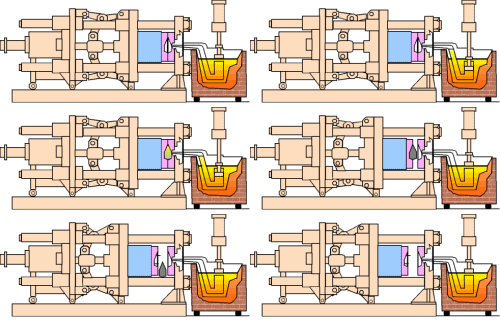
Zinc Die Casting Process is Direct Injection Zinc Die Casting for Cast Metal Parts. The zinc die casting process involves heat, pressure and of course, zinc to produce metal castings. With the help of machines especially designed to apply and handle these three elements, when combined together produces zinc dies. The machine used in the zinc die casting process is the hot-chamber machine.
The zinc metal die casting process begins when zinc is placed on a very high temperature. The high temperature is then absorbed by the zinc. The zinc becomes soft and malleable. While the zinc is at its malleable state, it is shot at high pressure (usually 1,500 to 25,000 psi.) into the die. The die is lubricated beforehand. The lubrication in the die has a two-fold purpose. First, the lubricant enables the zinc to be easily removed from the mold. Second, it allows the temperature in the mold to be easily controlled. Upon injection of the heated zinc, pressure is then applied to the mold until the soft zinc solidifies.
Direct-injection die casting is also used in the zinc die casting process. Also known as runner-less die casting, this procedure is employed in zinc die casting as it has many advantages. It has slower cooling cycles which enables it to produce better results. The cost of using this process is also cheaper as it does not use much energy.
Zinc die casting is preferred by many industries. This is because zinc is the metal which is the easiest to cast but still produces great outputs. It works well on small areas and lasts a long time.
Die Casting Processes with the Use of Zinc Alloy. Die casting is the process by which molten ferrous metal, e.g., zinc, magnesium, copper, lead, tin, aluminum, etc., are molded into cavities and placed under pressure to form. The method of die casting is ideal if the application needed is in large quantity and should be well-detailed and has fine quality. Zinc is a non-ferrous metal that is popularly used for die casting. This is due to the fact that zinc alloys have many characteristics that far exceed other metals. Zinc alloys have high strength and hardness, has high thermal and electrical conductivity, low cost, good finishing characteristics, outstanding fluidity, and excellent corrosion resistance among others.
In the zinc die casting process, two processes are involved, the hot chamber method and the cold chamber method. These two zinc die casting processes make use of various types of metal alloys during the production of parts in the zinc die casting process. The hot chamber method involves the process wherein a steel die is filled with a pool of molten metal, all the time maintaining pressure, until the metal hardens. The second process, the cold chamber method, involves the use of two separate chambers, first to melt, then to hold the melted zinc alloy before it is poured into a shot cylinder and afterwards inject them to the die casting die. Before, the metal alloys used in Zinc die casting processes are tin and lead. The zinc alloy however gained popularity and is now the first choice when it comes to die casting.
Zinc Parts Types. No doubt zinc is the best metal in die casting. Zinc is the easiest metal to cast because of its resistance to temperature and impact. Zinc parts are durable and have wider variety of applications than others, which are made of aluminum, magnesium, lead and tin. For several years, Zinc die casting has been the most popular casting process. This is because a number benefits are being offered by zinc die casting process.
It produces several zinc die casting parts. The best method that creates zinc parts with most fine finish and highest tolerance is die casting. In this process the zinc is subjected to pressure to make the die cast end up with more detailed parts than other parts of the cast. The zinc casting is highly suggested for the manufacturing of medium zinc parts.
The other popular method is sand casting that is suggested for the manufacturing of large zinc parts that require coarser surfaces. Sand casting is much more expensive than die casting. To produce all sizes of cast parts, the gravity-fed process is used. Comparing the three processes die casting heeds a fine finish and the production cost is much lower than with sand casting.
Die casting has reasonable and affordable tooling cost and most electrical and electronic equipment are made of zinc. The strength and hardness of zinc parts are not always present in parts that are plastic molded, sand cast, permanent mold cast, stamped, forge and screw machined.
Limitless and Yet Invisible, the Die Casting Zinc Revolution
Die Casting Zinc Parts, products that are quietly distributed in key markets in different industries around the world. Due to the limitless possibilities for zinc die casting applications, a number of firms are using die cast zinc metals.
Today they are found everywhere. Telecommunications, consumer electronics and medical devices, automotive markets, industrial markets; these are some examples. Metal die cast zinc parts are in the electronic and safety-critical applications of automobiles such as the anti-lock braking system, in micro components of mobile phones, in power tools and die cast model cars, wireless devices and their infrastructure equipment, inside electric motors, pumps, refrigeration equipment, and packaging equipment. Die cast methods are also used in the field of art to make metal sculptures for the garden, museum, or gallery.
Zinc die cast metal parts are everywhere, but sometimes we are not aware of its presence. This is how far we have come since the first smithy and the first metalworking activities of antiquity. Die cast zinc-aluminum alloy parts are in factory impellers, machinery housings and fittings, and other motor components as well as in consumer products around the house that we are barely aware of like gas grill parts, toys, and kitchen appliances. Other uses for zinc die casting products are house accessories like furniture parts, lamp and lighting, doors and windows, safe bolts and locks, water and plumbing fixtures. Miniature zinc parts are used in consumer goods and in the medical industry.
Think of any finished manufactured product and sure enough it has a zinc alloy die cast part in it. We just didn’t know. This is the quiet revolution of the metal die cast zinc parts.