Posts Tagged ‘Die Casting Zinc’
Protect Your Things with Zinc. Some of you may ask, “What exactly do we need zinc die casting boxes for?” After all, hundreds of these boxes are produced every day. What is the general purpose of these die cast boxes, anyway?
These boxes are very easy to produce. They are usually one-step molds in a hot chamber machine. They also protect most of your electrical appliances from not just heat, but also dust, moisture, and shock. They also provide Radio Frequency and Electrical Magnetic Inductance shielding - say goodbye to pesky cell phone interference with these die cast boxes!
alt="Zinc Die Casting Company" width="468" height="60" />
To get a price for zinc die casting parts or zinc die casting tooling,
call toll free 800-524-8083 and ask for sales. Or email us at
sales@diecastingzinc.com for a fast response on a price quote.
Open Your Doors with Zinc. A lot of the little, ordinary things around your household are probably made of die casting. You’d think, yes, that includes the sink faucet or the door locks. The parts of the car and the internal workings of the coffee maker are made of die casting. But the one you might not imagine that is made of die casting is your door knob.
alt="Zinc Die Casting Company" width="468" height="60" />
To get a price for zinc die casting parts or zinc die casting tooling,
call toll free 800-524-8083 and ask for sales. Or email us at
sales@diecastingzinc.com for a fast response on a price quote.
The Advantages of Die Casting Using Zinc. The concept of die casting is basically the process of forcing molten metal into mold cavities using high pressure. Most of the die casting done in the market are made from metals that are non-ferrous including but not limited to zinc. However, it is also possible to do die casting with the use of ferrous metals, but this is seldom done. Other non-ferrous metals that are used for die casting are copper, lead, tin, etc. Zinc is a popular metal for die casting due mainly to the zinc alloy’s favorable characteristics and advantages over other materials and processes.
One advantage of zinc die casting is the metal’s high strength and its hardness. Zinc die castings are famous for their great impact strength compared to other materials. It may not be stronger than steel but stronger than “steel weldment”. Another preferred advantage of zinc die casting is its castability feature. This is due to the fact that zinc has a fluid nature that beats other metals. Likewise, zinc has a longer die life. In zinc die casting, the die life is 1 million shots before the need for replacement occurs. This is 10 times longer that what is found in other materials like aluminum die casting. The possibility of easier parts consolidation in zinc die casting due mainly to its higher fluidity makes it another advantageous feature of the metal. Lastly, zinc is not expensive compared o other metals and therefore the practical choice for many die caste. It is also readily available. More advantages can be found when die casting zinc. Online sites can provide the information readily.
Zinc Castings – Techmire Die Casting. At present, one major company engaged in the industry of metalworking is Techmire. This company has been creating several die casting machines from the small tradition die cast business up to the established companies. Its main factory is located in Canada, but still manages to serve clients from 30 other countries. It is also known to provide excellent customer service because they have different ways to communicate with their clients. They can be contacted through fax, telephone and internet.
Techmire Zinc Die Castings are created through zinc-designed die casting equipment. Two different groups of equipment for zinc castings are manufactured by the company. These are the NTX Series and NT Series of Techmire Zinc Castings equipment.
The NTX Series Techmire Die Castings include the newest technology such as the clamping system, which has the capability to handle velocities, higher capacity and extreme pressures. This new technology produces end products that have an enhanced surface finish and better zinc part density. The NTX series have three different machine models, the 88 NTX, 44 NTX and 24 NTX. All three machine models give various purposes for different products, but they are all similar to giving rigidity, enhanced cycle speeds, heavier load bearings, also the handling of larger surface area parts and smaller components. Furthermore, it offers other enhancements for the creation of different zinc parts.
On the other hand, the general purpose NT Series Techmire Zinc Castings are fully automatic, high precision and hot chamber die casting equipment utilizing lots of slide technology. The three NT Series models; 66NT, 44NT and 22NT, offers a dissimilarity in standard die size and suggested shot weight.
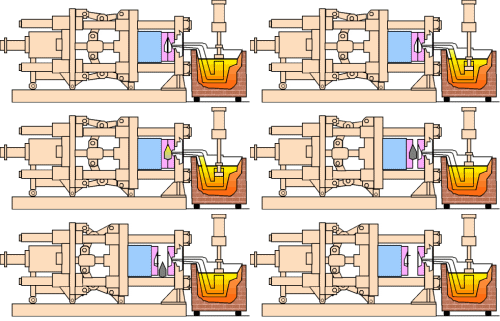
The Process of Hot Chamber Zinc Die Castings. A Hot Chamber machine is especially used for low melting point alloys like magnesium, zinc and copper, which don’t quickly damage metal hot chamber pots, plungers and cylinders. One popular hot chamber die casting process used is the Hot Chamber Zinc Castings process. Because it provides high rate of productivity, more and more companies are using the Hot Chamber Zinc Castings process.
In the process of Hot Chamber Zinc Die Castings, strips or rods of metal zinc will be melted inside a hot chamber at about 700-800 degrees Fahrenheit. While the zinc metal is inside the hot chamber, the gooseneck, commonly called as the shot sleeve, will be plunged into the hot chamber. Then the molten zinc metal is injected straightly from the hot chamber, inside the pair of die halves that are attached in the Hot Chamber Zinc Die Castings machine.
After that, the molten zinc metal will be infused with hydraulic pressure inside the pair of die halves. The molten zinc will be held under a high pressure in anticipation of the solidification of the metal. The waiting time is commonly about 15 seconds, but it still depends on the size of the parts. Afterwards, the pair of die halves will be opened and all the parts will be removed either by hand or with the use of a machine. Finishing touches like assembly, chrome plating, anodizing, painting, precision machining, tumble deburring and trimming will be followed.
That’s how the process of Hot Chamber Zinc Die Castings works. It may look simple but it requires regular monitoring and hard work to produce a perfect material.