Posts Tagged ‘Zinc Die Castings’
What is Zinc Die Casting? Die Casting is a method wherein the molten metal is pressed down in high pressure into the mold cavities. It can be done in two ways, the hot chamber process and the cold chamber process. Die castings are mostly made out of non-ferrous metals like tin-based alloys, lead, magnesium, aluminum and copper. But the most popular non-ferrous metal used is zinc.
Because it is very easy to cast and the fact that zinc has numerous functional and decorative applications, no other methods or materials in die casting will match the economics and properties of Zinc Die Casting. Zinc alloys are more durable compared to strengthened molded polymers. The zinc is appropriate for working mechanical parts like pinions and gears because of its high modulus, dimensional stability, hardness and self-lubricating properties.
Zinc Die Casting has many advantages over other manufacturing procedures.
-
1. Compared to plastic molding, zinc die cast creates tougher parts through closer endurance to have better stability, plus it can withstand extreme temperatures.
2. Compared to sand castings, zinc die casts create parts with smoother surfaces, thinner walls and closer dimensional limits. The production is also faster with zinc die cast.
3. Compared to screw machine products, zinc die cast needs lesser operations and decrease scrap and waste. It can also produce figures that are hard to make like tubular stock and bar, while sustaining tolerances with no tooling changes.
From automotive and limitless electronic components to office equipment, tools and window hardware as well as doors and bathroom fixtures, there’s no doubt that Zinc Die Casting has definitely made a great impact in our lives.
Understanding Zinc Die Casting Process. It has been known that the best material used in die casting is the zinc because of its significant characteristics. So now, it’s time for you to know the simple process of Zinc Die Casting. But before understanding the Zinc Die Casting Process, it is important for you to have an idea about the different process of Die Casting.
The standard process of Die Casting has four stages:
-
1. Oil will be coated all over the mold. Afterwards, the machine will be closed. The coated oil will control the die’s hotness and it will take away the casting.
2. Under high pressure, between 1,500 to 25,000 psi, the die will then be injected with molten metal. After filling the molten metal with die, pressure will be retained, waiting for the casting to get hardened.
3. After that, the die will be opened, and with the use of ejector pins, shots will be ejected.
4. Lastly, with the use of a particular trim die, the flash, sprues, runners and gate included in scrap, will be removed from the castings under hydraulic press or power press.
Another process is called Pore-Free Casting, which is very different with Zinc Die Casting Process, but it can be done using zinc alloys. The method used is the same with the standard die casting process, but with Pore-Free, before every shot, oxygen is inserted within the die.
Now, let’s go to the Zinc Die Casting Process. In this process, the molten zinc will be injected all the way through a hot manifold to the hot mini-nozzles, directly to a molding cavity. Zinc Die Cast Process helps reduce the expense for each part by removing runners, gates and sprues as well as energy conservation. Also, it provides greater surface quality by means of a slow-paced cooling sequence.
Those are the different Die Casting process used by different die cast manufacturers.
Zinc Castings – Techmire Die Casting. At present, one major company engaged in the industry of metalworking is Techmire. This company has been creating several die casting machines from the small tradition die cast business up to the established companies. Its main factory is located in Canada, but still manages to serve clients from 30 other countries. It is also known to provide excellent customer service because they have different ways to communicate with their clients. They can be contacted through fax, telephone and internet.
Techmire Zinc Die Castings are created through zinc-designed die casting equipment. Two different groups of equipment for zinc castings are manufactured by the company. These are the NTX Series and NT Series of Techmire Zinc Castings equipment.
The NTX Series Techmire Die Castings include the newest technology such as the clamping system, which has the capability to handle velocities, higher capacity and extreme pressures. This new technology produces end products that have an enhanced surface finish and better zinc part density. The NTX series have three different machine models, the 88 NTX, 44 NTX and 24 NTX. All three machine models give various purposes for different products, but they are all similar to giving rigidity, enhanced cycle speeds, heavier load bearings, also the handling of larger surface area parts and smaller components. Furthermore, it offers other enhancements for the creation of different zinc parts.
On the other hand, the general purpose NT Series Techmire Zinc Castings are fully automatic, high precision and hot chamber die casting equipment utilizing lots of slide technology. The three NT Series models; 66NT, 44NT and 22NT, offers a dissimilarity in standard die size and suggested shot weight.
Techmire Technology Zinc Die Castings. Ruling the metalworking industry because of its revolutionized approached to die casting, Techmire found its market in providing companies with equipment for all possible zinc die casting projects. It initially catered to its clients in its homeland in Montereal, Canada way back in 1973. It then expanded and was able to supply countries in neighboring areas. Techmire zinc castings are now being used in more than thirty countries all over the world. Inquiries and concerns are addressed by the company for technical assistance.
Techmire zinc castings employ the Techmire technology zinc die casting which is most beneficial to zinc die casting projects. Among the benefits that the Techmire technology offers are the following: low production cost, efficient operations and high-quality finish
Techmire zinc castings do not require much in terms of production. The materials needed as well as the labor are reduced. Techmire zinc die castings are also efficient. The cycle times are faster resulting to greater productivity.
Though the costs of production and the cycle times are faster, Techmire zinc castings do not sacrifice the quality of the output itself. The precision and quality are kept intact. Top quality outputs are expected each time.
The machines designed by Techmire are specially made to cater to zinc products. Two die casting equipments are NT Series and the NTX Series. The NT series are hot chamber zinc die casting machines that makes use of multiple slide technology. The NXT, on the other hand, is more advanced than NT. NT can hold a larger amount of molten zinc and can apply a higher amount of pressure.
Hot Chamber Zinc Castings 800 degrees Fahrenheit. The most ideal machine used in zinc die casting is the hot chamber. Hot chamber zinc casting is the common method used in zinc because it does not require a very high temperature in order to melt the metal. Metals with high-melting point such as aluminum do not do well in hot chamber casting. There is a tendency that the metal will absorb the iron in the machine. Hot chamber die casting is used in other alloys that have low-melting point such as copper and magnesium.
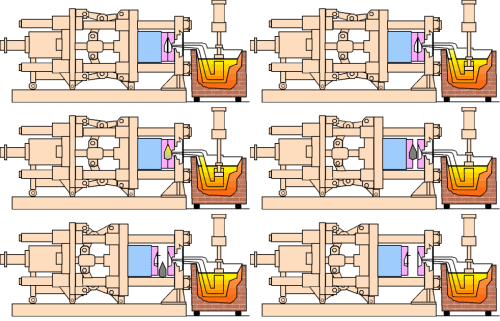
The process in hot chamber zinc die casting begins with melting the slabs of zinc in the furnace. In order for zinc to reach its melting point, heat must be approximately 700-800 degrees Fahrenheit. As soon as the zinc reaches its melting point and turns liquid, it is then displaced through a shot sleeve. Known as the goose’s neck, the sleeve is dipped in the furnace and then injected into the die. Pressure is applied until the zinc returns to its solid state while retaining the shape of the die cast. To make the casting process easier, lubricants are applied to the mold. This helps the removal of the molded zinc as well as the control of the temperature easier. In some instances, robotics is employed to remove the molded metal. The solidification process usually takes 2-15 seconds.
Other operations after the hot chamber zinc casting are performed to polish the molded metal. Such operations include trimming, painting and plating. This makes the details of the casted zinc more precise and functional.