Die Casting– Different Zinc Parts Types

Die Casting – Different Zinc Parts Types. The Zinc Die Casting has been very popular around the world for a very long time simply because it gives lots of benefits. Additionally, the three methods of Zinc Die Casting make various Zinc Parts Types.

The first and the oldest Zinc Die Casting method is the customary die casting. This method creates Zinc Die Cast Parts which have the most remarkable fine veneer and maximum tolerance. Die Casting Method is suggested for the creation of tiny to average Zinc Die Cast parts.

The second method called Sand Casting is suggested to be used for the creation of big Zinc Die Cast Parts which need unrefined surface.

The gravity-fed casting is the third method of Zinc Die Casting parts. It is the most common choice that’s why it is mostly used for the creation of Zinc Parts Types in any sizes.

Nowadays, many industries have been using Zinc Parts Types out of Zinc Die Castings. At times, golf clubs and zinc automotive parts are made with the use of zinc die casting method in addition to zinc home hardware parts like zinc lock cases which are used for security system.

Here is a list of the few Zinc Parts Types that are used in our everyday lives:

1. Fishing lures
2. Golf club putters
3. Pump valves
4. Pumps
5. Pump handles
6. Pump rotors
7. Power tools
8. Zinc door knobs
9. Kitchen hardware
10. Frames and cases
11. Heat sinks
12. Handles, Door handles
13. Motorcycle grips
14. Flanges
15. Faucets
16. Fire alarm case
17. Die-cast toys
18. Die cast cars
19. Carburetors
20. Hooks

Posted in Zinc Parts | Tagged , , , , | 4 Comments

What is Zinc Die Casting?

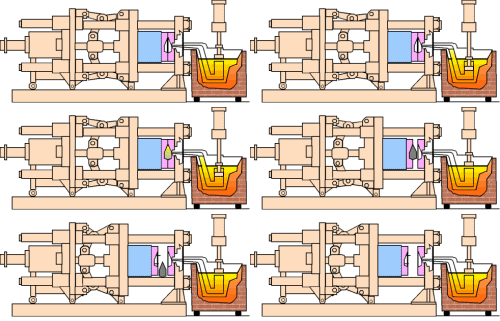
What is Zinc Die Casting? Die Casting is a method wherein the molten metal is pressed down in high pressure into the mold cavities. It can be done in two ways, the hot chamber process and the cold chamber process. Die castings are mostly made out of non-ferrous metals like tin-based alloys, lead, magnesium, aluminum and copper. But the most popular non-ferrous metal used is zinc.

Because it is very easy to cast and the fact that zinc has numerous functional and decorative applications, no other methods or materials in die casting will match the economics and properties of Zinc Die Casting. Zinc alloys are more durable compared to strengthened molded polymers. The zinc is appropriate for working mechanical parts like pinions and gears because of its high modulus, dimensional stability, hardness and self-lubricating properties.

Zinc Die Casting has many advantages over other manufacturing procedures.

1. Compared to plastic molding, zinc die cast creates tougher parts through closer endurance to have better stability, plus it can withstand extreme temperatures.

2. Compared to sand castings, zinc die casts create parts with smoother surfaces, thinner walls and closer dimensional limits. The production is also faster with zinc die cast.

3. Compared to screw machine products, zinc die cast needs lesser operations and decrease scrap and waste. It can also produce figures that are hard to make like tubular stock and bar, while sustaining tolerances with no tooling changes.

From automotive and limitless electronic components to office equipment, tools and window hardware as well as doors and bathroom fixtures, there’s no doubt that Zinc Die Casting has definitely made a great impact in our lives.

Posted in Die Casting Zinc | Tagged , , , , , , , | Leave a comment

Zinc Die Cast- The Tooling Process

Zinc Die Cast – The Tooling Process

If you hear someone say the phrases like “insert dies”, “Zinc Die Casting Molds” or “Zinc Die Casting Dies,” that person is referring to the Zinc Die Casting Tooling. It has various styles, sizes, and forms and it either comes with one cavity or numerous cavities.

Zinc Die Casting Tooling is built of metal tool alloys separated into 2 parts, which are the ejector-die half and the fixed-die half. Newer version of dies may possibly have movable cores, slides or further sections in order to create threads, holes, and other preferred contours. The sprue holes placed in fixed-die half, directs the molten metal through the die until the cavity becomes full. Typically, the ejector-die half is composed of inlets and passageways that guide the molten metal through the cavity. The dies have holes for cooling fluid agent and grease, locking pins for the security of the pair of halves and ejector pins to help eliminate the cast part in the equipment.

Every so often, zinc parts require trim tooling. As soon as a zinc part is created by the Zinc Die Casting Tooling machine, the extra zinc surrounding the parts of the zinc will be smoothened by the trim die tool. The die is placed into the trim press wherein the ejector-die half and fixed-die half are put on hydraulic pressure so that it will be easier to sheer and trim the materials all together. With the use of trim dies the production process of zinc part is faster. As a result, at least 15% in the cost of the zinc part is saved.

Posted in Zinc Die Casting Tooling | Tagged , , , , , | 1 Comment

Understanding Zinc Die Casting Process

Understanding Zinc Die Casting Process. It has been known that the best material used in die casting is the zinc because of its significant characteristics. So now, it’s time for you to know the simple process of Zinc Die Casting. But before understanding the Zinc Die Casting Process, it is important for you to have an idea about the different process of Die Casting.

The standard process of Die Casting has four stages:

1. Oil will be coated all over the mold. Afterwards, the machine will be closed. The coated oil will control the die’s hotness and it will take away the casting.

2. Under high pressure, between 1,500 to 25,000 psi, the die will then be injected with molten metal. After filling the molten metal with die, pressure will be retained, waiting for the casting to get hardened.

3. After that, the die will be opened, and with the use of ejector pins, shots will be ejected.

4. Lastly, with the use of a particular trim die, the flash, sprues, runners and gate included in scrap, will be removed from the castings under hydraulic press or power press.

Another process is called Pore-Free Casting, which is very different with Zinc Die Casting Process, but it can be done using zinc alloys. The method used is the same with the standard die casting process, but with Pore-Free, before every shot, oxygen is inserted within the die.

Now, let’s go to the Zinc Die Casting Process. In this process, the molten zinc will be injected all the way through a hot manifold to the hot mini-nozzles, directly to a molding cavity. Zinc Die Casting Process helps reduce the expense for each part by removing runners, gates and sprues as well as energy conservation. Also, it provides greater surface quality by means of a slow-paced cooling sequence.

Those are the different Die Casting process used by different die cast manufacturers.

Posted in Die Casting Zinc | Tagged , , , , , , | Leave a comment

Zinc Castings-Techmire Die Casting

Zinc Castings – Techmire Die Casting

At present, one major company engaged in the industry of metalworking is Techmire. This company has been creating several die casting machines from the small tradition die cast business up to the established companies. Its main factory is located in Canada, but still manages to serve clients from 30 other countries. It is also known to provide excellent customer service because they have different ways to communicate with their clients. They can be contacted through fax, telephone and internet.

Techmire Zinc Castings are created through zinc-designed die casting equipment. Two different groups of equipment for zinc castings are manufactured by the company. These are the NTX Series and NT Series of Techmire Zinc Castings equipment.

The NTX Series Techmire Zinc Castings include the newest technology such as the clamping system, which has the capability to handle velocities, higher capacity and extreme pressures. This new technology produces end products that have an enhanced surface finish and better zinc part density. The NTX series have three different machine models, the 88 NTX, 44 NTX and 24 NTX. All three machine models give various purposes for different products, but they are all similar to giving rigidity, enhanced cycle speeds, heavier load bearings, also the handling of larger surface area parts and smaller components. Furthermore, it offers other enhancements for the creation of different zinc parts.

On the other hand, the general purpose NT Series Techmire Zinc Castings are fully automatic, high precision and hot chamber die casting equipment utilizing lots of slide technology. The three NT Series models; 66NT, 44NT and 22NT, offers a dissimilarity in standard die size and suggested shot weight.

Posted in Miniature Zinc Parts | Tagged , , , , , , , , , , , | Leave a comment