Puchasing Zinc Die Cast Parts Today

Die Cast Zinc parts created from zinc die-castings have many uses for many industries. Even your favorite nameplate parts are produced mostly by employing die casting zinc parts processes. It also includes zinc automotive parts and various zinc home hardware parts (zinc lock housing used in security systems). The zinc die casting process, together with high technology equipment makes for precision in the defining of product dimensions, stable surfaces, and an efficient casting to complex shapes.

The surface finishing process would include polishing, powder and brass coating, chrome and nickel plating to make the surfaces of the parts visibly smooth and shiny.

Other zinc die-casting parts available everywhere in the market these days include the following everyday applications:

  • Automotive castings
  • zinc hooks and handles
  • carburetors
  • zinc decorative hardware
  • zinc cover
  • die-cast cars
  • zinc door handles
  • faucets
  • motorcycle handles
  • kitchen hardware
  • zinc housings
  • pumps
  • pump valves
  • fishing tackle
  • golf club putters, and
  • so many more!
  • Die-casting companies anywhere makes die cast parts using various alloys, with zinc as the easiest to cast. Some also utilize aluminum and brass when die-casting. The zinc die-casting alloy is also commonly known as “Zamak”, and it includes the zinc-aluminum (ZA) family of die-casting alloys. Examples found here www.diecastingzinc.com/zinc_alloy.html

    Zinc parts created using zinc die-casting alloys presents a wide range of impressive mechanical and physical properties useful in so many industries. Such alloy types are also known for its excellent casting ability and various finishing characteristics. Even thinner than usual sections can be readily die-cast using zinc alloy. It generally allows for greater section design variations and better maintenance with closer dimensional tolerances.

    There are mainly two processes utilized by every zinc die-cast parts company when making parts:

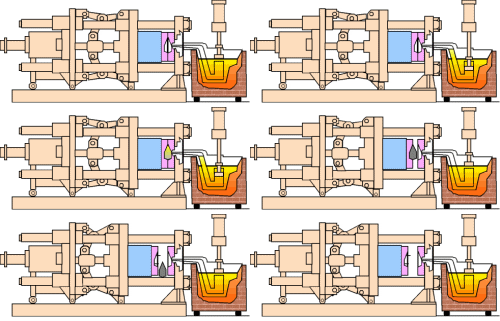
    The hot chamber method – makes use of an internal plunger system that injects the zinc material from molten zinc metal to fill up the steel die, while at the same time maintaining the pressure all the way until it hardens up the die.

    The cold chamber method – this particular process makes good use of separate chambers when melting and holding the zinc metal before it is injected using die-casting shot cylinders.

    The impact of the zinc component strength is relatively and influential compared to other standard die-casting alloys available in the market these days, with the slight exception of brass. The much lower pressures and temperature needed in die-casting using zinc alloy makes for a significantly lengthened die life, which also means minimal die maintenance. Surprisingly, there are numerous differences between two of the most commonly used alloys when die-casting, zinc and aluminum parts. Die-cast zinc parts reportedly weigh more than the aluminum component, and it melts in lesser temperatures where aluminum could not. It also needs less draft angle, as it is more malleable than aluminum.

    Die Casting Zinc is a Zinc Die Casting Company which manufactures zinc die casting parts using zinc die casting alloys. Look at this website page for more details: www.diecastingzinc.com/zinc_alloy.html. Contact us at 800-524-8083 or email us at sales@diecastingzinc.com

    Posted in Zinc Parts | Tagged , , , , , , , | Leave a comment

    Die Casting Zinc Company-Soaring to New Heights

    Diecasting is characterized as a metal casting procedure that forces molten metal into die casting mold cavities through high pressure. The mold cavity is designed via a pair of hardened tool steel dies machined into the right features, which functions just like an injection mold deep along the way. Most of today’s diecastings are created from non-ferrous types of metals, with zinc based alloy as the most accepted. This is where the DieCastingZinc.com Company based its foundation.

    Zinc is generally the most accessible alloy to cast. With its high ductility and high impact strength, employing the zinc material makes for easy plating that proved inexpensive when it comes to small parts. Using zinc material also promotes a much longer die life.

    Manufacturers these days tend to rely more towards zinc die casting because of the versatility offered by zinc die casting parts used in the process. Such die casting parts are available in various shapes, sizes and texture that come in handy whenever customers think about customization. Such parts are also proven to provide notable dimensional tolerances to almost any given conditions complete with multiple secondary options. Aside from the available choices of finished products that such zinc die casting parts offer, everything that comes out of the market also demonstrates an exceptional longevity feature. This is because they are made more durable than their earlier counterpart, the method called plastic injection molding.

    When interested buyers take into consideration the strength and the weight, zinc die cast parts are the nicer option, probably much better than anywhere. While the wall on the castings is visibly thin (perhaps the thinnest of the walls among casting end products) and obviously lightweight, it still remains very durable, and also made to last for a very long time. Indeed, some parts are made to last a lifetime, so long as they are properly cared for. This can be easily accomplished though since zinc die cast parts are not really synonymous with high maintenance, and the costs that come along with it.

    These special parts www.diecastingzinc.com are also reportedly much cheaper than their traditional counterparts in the market and the industry these days, particularly those manufactured from other standard casting methods, such as sand casting, stamping and forging. This is so since standard zinc die casting processes do not really need an intensified pre and post-production assistance from tools and machines. It is another feature that many consumers are after because zinc parts production can now be processed with reasonable costs. This is good news indeed to the industrial world, whether in car assembly lines, the much simpler fixing of faucets and connection of pipes, to the making of commercial toys.

    You now understand how the Zinc Die Casting Company functions with the die casting parts made available to the market. It is also good to know that you can readily order them online through their official website at very reasonable prices. Whatever your choice is, you can be sure to get everything according to your specifications.

    Die Casting Zinc is a Zinc Die Casting Company who manufactures zinc diecast parts and also Die Casting Tooling. Look at this website page for more details: www.diecastingzinc.com/tooling.html. Contact us at 800-524-8083 or email us at sales@diecastingzinc.com

    Posted in Die Casting Company | Tagged , , , , , , , , , | Leave a comment

    Zinc Parts Also Die Casting Machines

    Evaluating zinc hardware is no walk in the park. Multiple-slide zinc die-casting machines are perfectly capable of producing complex zinc components with precision. This extends to the planning, designs and the building of die casting dies, the selection of various auxiliary equipment and personnel training services.

    The die-casting process, whether it uses zinc alloys or other materials for casting is generally characterized by applying molten metal into mold cavities via high pressure (though zinc can be readily cast with just minimum melting point, much better compared to its other metal alloy counterparts). Depending on the metal type used in the casting process, hot or cold chamber machines will be used in the operation. Both are distinguished by the amount of clamping force that they are able to apply separately. Typical ratings are recorded in between 4,000 and 400 ST.

    Casting equipment using zinc and metal dies exhibits huge capital costs; these tend to limit high volume productions. The production of parts through zinc die-casting is somewhat simple enough in terms of the operation, which is divided in four types as this keeps incremental costs per item at a low. It is best suited in large quantity manufacture of small and medium-sized diecastings because of the significant savings that will be gained out of it. This is probably the main reason why die-casting is more feasible these days compared to other casting processes.

    Hot-chamber die casting machines are also referred to as “gooseneck machines.” Its operation relies on molten metal. During the beginning cycles, the machine’s cylinder will be retracted, allowing molten zinc to fill it all up. The hydraulically powered piston will force the zinc out of the gooseneck and into the die. What this particular machine does best is the fast cycle times reported at an average of fifteen cycles in a minute, which makes for an efficient and convenient melting of zinc in the die casting machine (see www.diecastingzinc.com/hot_chamber.html).

    While the advantages about the machine brings efficiency and potential savings at whole new levels, its drawbacks are among the issues worth noting. One particular disadvantage of the hot chamber system is that it cannot accommodate metals with high-melting points. Zinc however is an exception, and this is where zinc hardware in die-casting parts proves more feasible compared to its counterparts in the industry.

    Cold chamber machines on the other hand are called into action when the casting alloys used cannot be accommodated in hot chamber machines. Such metal alloys include zinc alloys with a great part of aluminum, aluminum itself, copper and magnesium. The casting process commence with molten metal created in separate furnaces. Precise amounts of molten metal are transported directly to the cold chamber machine, and will be injected into the slot chambers (injection cylinders), which by the way, should not be heated. The shot will be driven all the way into the die via mechanical or hydraulic pistons.

    Among the drawbacks of the system is a much slower cycle time, the result of the difficulty when transporting molten zinc alloy from the separate furnace and into the cold chamber machine. This alone is one complicated task. Given the right conditions, zinc hardware operations are a great opportunity for building operations during operations.

    Die Casting Zinc is a Zinc Die Casting Company who produces zinc metal die casting parts. Look at this website page for more details: www.diecastingzinc.com/metal_parts.html. Contact us at 800-524-8083 or email us at sales@diecastingzinc.com

    Posted in Zinc Parts | Tagged , , , , , | Leave a comment

    Various Forms of Zinc Casting

    Various Forms of Zinc Metal Parts Casting. Zinc metal parts is thought as adaptable, primarily because it is one of the few metals around that can be cast using all sorts of casting procedures. Die casting, sand casting, plaster casting, nonstop casting, investment casting and permanent mold casting, in this case, all fall under zinc casting. Squeeze casting, lost foam, and hot isostatic pressing are also some applications connected with the method.

    When pondering on which method of zinc casting to utilize, one must take into account the cost of each type and the quality of material that it will give way. Several zinc alloy castings are finished using the above methods, but the difference in results are immense and numerous in numbers. For example, when dies casting, air can be ensnared in the casting and thus results in porosity. It cannot be removed, and zinc die castings are thus lower in potency than mold castings.

    Die casting is chiefly catered towards zinc alloys because it is deemed the greatest material for the procedure, and it is easy to get. It is also the most accepted zinc casting method and is excellent for mass production of tiny, in depth parts. Millions of copies of alloys are manufactured to serve as parts for numerous machines and tools, noticed everyday in a person’s life. Many house tools are created utilizing zinc die casts, and several structures outside also need similarly small parts. Permanent mold casting, on the other hand, is improved suitable for much larger parts and thus give way in stronger material for much finer mechanical structures.

    Posted in Metal Parts | Tagged , , , , , , , | Leave a comment

    Three Types of Zinc Castings

    Three Types of Zinc Castings. DieCastingZinc castings are utilized to by a lot of metalworking companies to form the ideal zinc material, without it being to expensive and wasting a lot of time. Due to the adaptability of these methods, a lot of companies have turned to this unusual way in forming one of the most reliable alloys that is utilized for numerous workings in the same industry. There are a lot of items that were fashioned out of zinc castings from the Washington Monument’s cap to the antique tea kettles utilized by people who lived hundreds and hundreds of years ago. Although there have been a lot of improvements in the procedures of zinc castings, most of the companies still resort to the traditional means of using melted metal to fashion some of the most complex dies in history.

    Zinc castings can come in three varied procedures. Out of the three (permanent mold casting, sand casting and die casting), die casting is thought of as the most well-liked among all companies in the metalworking industry. Even though sand casting is known to be more adaptable due to its delicate patterns, die casting prove to manufacture the sturdiest components utilized by a lot of automobile franchises and even the tiniest of modern electronic gadgets. Other would say, nonetheless, that permanent mold castings also construct durable materials, but may require more costly equipments and methodologies contrasted to the two other processes. Although these three methods may have a lot of differences, it can be decided that zinc castings are extremely efficient in whichever method they are performed under.

    Posted in Die Casting Zinc | Leave a comment