Zinc Die Cast Tools

Zinc Die Cast Tools. In the metalworking industry, zinc die casting has become one of the highest grossing processes manufacturers can take advantage of. This process is known to be best used when a large amount of small or medium sized parts are needed. The resulting products from this process are of high quality, with a very smooth finish, good detail and the parts are consistent in terms of their dimensions. It has been said that the difference between each part from this process are so small that the need for post machining to correct the problem can be eliminated altogether.

Although ferrous metals can also be used in the process of zinc die casting, non ferrous materials are usually used instead of these. Examples of commonly used metals are tin, zinc, lead, aluminum and magnesium among other metals. Steel and iron are too strong and too hard to be used in zinc die casting; instead they are used to create one of the Zinc Die Cast Tools known as the mold.

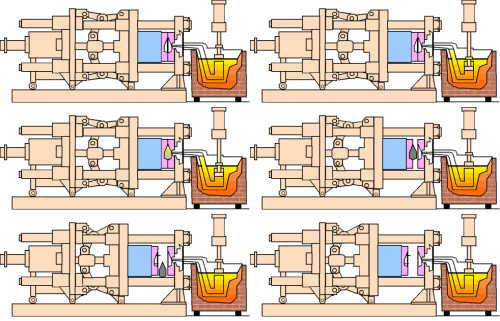
The mold is where the molten metal is forced into under a high pressure environment. The molten metal enters every crevice of the mold and forms the part after they are machined by the next Zinc Die Cast Tools known as hot chambered machine and cold chambered machine.

Both hot chambered and cold chambered machines can be used in this process; the main difference is that although the former performs faster and better, cold chambered machines are used for metal alloys which the hot chambered machine cannot handle. This tool completes the whole process of zinc die casting.

Posted in Zinc Die Casting Tooling | Tagged , | Leave a comment

Zinc Die Casting Company Die Casting Process

Zinc Die Casting Company Die Casting Process. Zinc Die casting is a process that requires great pressure to force the metal to melt and mold it into different shapes. It is best for applications that require a large quantity of small- or medium-sized parts that require good detailing, with fine surface quality, and with a dimensional consistency.

Die casting process is done using non-ferrous metals like zinc, copper, aluminum, magnesium and others. Zinc die casting process is among the most famous castings done in an alloy. The process involves four steps: spraying, filling, opening, and scraping.

The first step is done by spraying a lubricant onto the mold. Lubricant controls the temperature of the die and assists in removing the cast. Second step in zinc die casting process includes filling of die into the molten metal under high pressure. The die is then opened once it solidifies, and the ejector pins eject the shot. Scraping takes place next, wherein the scrap, including the runners, gate, spues, and flash are removed from the casting. Scraping in zinc die casting process is done with the use of a special trim die in a hydraulic press or power press. The conventional method is by sawing or by the use of the hand in which grinding is necessary to remove the scrap marks.

Another way is to tumble shot if the gates are easily broken and thin. Gates and the finished parts should be separated. The scraps are recycled by melting them again and molding them into different shapes and sizes.

Posted in Die Casting Company | Tagged , , | Leave a comment

History and Production

Miniature Zinc Die Castings: History and Production. Casting is the process of reproducing an object with the use of a pattern or mold. A material is poured into a mold and then allowed to solidify. This solidified material exactly replicates the patterns in a mold. This replica is called the product. Large amounts of a single object can be replicated by using the casting process. Many products can come out of a single mold. Artists are familiar with casting for creating sculptures, usually made of bronze, sometimes made of plaster. Some of the materials used for a mold in the casting process are sand, plaster, rubber latex, sand-resin mix, or metal. The history of casting is the history of human civilization. We have been using this process for 6000 years. The 1st mention of the methods of casting was in the ancient Sanskrit texts.

Most importantly, the casting process is also well suited in manufacturing industries due to its capacity for mass production. Nowadays, miniature zinc die castings for industrial uses are made in this way. Zinc is the casting material and another stronger metal is fashioned into the mold. This process is called die-casting because the metal mold is also called a die. The zinc, when in its liquid form, is pressure injected into the metal die-mold. When solidified, the zinc then takes the shape and the patterns of its mold. It can now be ejected. The process can be repeated countless times until the metal mold gives out, which can take a long time. In the meantime the manufacturing of the miniature zinc die castings can continue on and on. Tooling machines for die casting include the die-mold, the pressure-injection, and the means for cooling and ejecting the product.

Posted in Die Casting Zinc | Tagged | Leave a comment

Zinc Die Castings

Zinc Die Castings. A process in which alloys are forced to melt using high pressure and molded into steel, which is reusable is called die casting. These dies are molded to create shapes with great degree of repeatability and accuracy. It is best for different variety of serviceable and attractive finishes. Its parts are defined sharply, with surfaces that are textured or smooth.

Among the list of alloy to cast, zinc is the easiest. It has high impact strength, and high ductility that can be easily plated. The Zinc die casting is cheaper for small parts. It promotes long die casting tooling life and also has low melting point.

The first die casting started in mid 1800s using the alloys tin and lead. The process is done by injecting a pressure. The patent for machine used in printing type cast, which is operated manually was awarded to Sturges in 1849. In 1914, the use of tin and lead in die casting has reduced with the birth of aluminium and zinc alloys. Since then zinc die casting has become the famous die casting in the world. Hot Chamber zinc die casting as compared to aluminium die casting requires greater heat since aluminium has a great strength at high temperatures. Unlike zinc, aluminium is a lightweight alloy, with high dimensional stability for complex shapes and thin walls. Zinc is the easiest to cast so it became the most sought-after alloy in the industry of engineering.

Die casting process is economical and efficient as compared to other manufacturing processes that offer a broad range of components and shapes. It is designed to compliment different parts and have longer service life parts. The designers using die cast can gain number of benefits and advantages.

Posted in Zinc Parts | Tagged , , | Leave a comment

Zinc Miniature Die Casting

Zinc Miniature Die Casting. In miniature zinc parts designing, the zinc die casting process has significantly evolved. Zinc miniature die casting has produced tiny geometrically designed complex parts with several features, great precision, thin walls, multi cored holes, and a flash-free, sculptured shutoffs.

Some companies have been producing miniature zinc die casting for several years. Using their four-slide, high-speed machines, which are microprocessor-controlled, they were able to offer their customers, engineered products, tool designs, rapid prototyping, maintenance, and manufacturing.

According to experts, miniature designs require a special approach to design and engineering. To be able to create a miniature zinc die casting design a designer must put all the disciplines together on the part design, tooling, and processing. There are things that are needed to consider in designing a zinc miniature die casting. The design should conform to the minimum thickness of .014 inches.

Die Casting Tooling layout should match the geometry to assure proper fill and gating, ability to overflow thin wall sections, proper tool control and half registration, ability to eject part consistently, ability for runners to degate, parting lines optimal location and proper cavitation. The designer should also analyze the operations for secondary options and operations for sequencing.

To ensure success, it is important to disclose the post-cast forming operations. Consider the effect of plating on features and tolerance if the parts require plating for cosmetics or corrosion protection. These are only some of the few things that are needed to consider in zinc miniature die casting. This type of casting requires deeper considerations on the die cast supplier earlier before the start of the process.

Posted in Miniature Zinc Parts | Tagged , | Leave a comment