Posts Tagged ‘Zinc Die Casting Tooling’

Hot Chamber Zinc Castings. The die casting process has become widely popular over the decades. Since a patent was granted to Sturges in 1849, the die casting process has gained patronage from all parts of the industrialized world. Today, there are hundreds upon hundreds of companies that manufacture and sell die cast parts, which are also referred to collectively as die cast tooling. Die cast parts, as known by many, can be created using different materials. The first ones introduced were tin and lead, but the birth of zinc die cast parts in 1914 saw the beginning of a new era in the die casting community. Although copper and aluminum soon followed, zinc and its alloys, whether for hot chamber zinc castings or cold chamber zinc castings, were and still are the favorite die casting materials.

The die casting process in its most basic state consists of injection molten metal into a die (a steel mold) under high pressure. Die casting machines come in various sizes; they are usually rated in clamping tons which are the equivalent of the amount of pressure they will be able to exert on the die or steel mold. But whether a machine is sized at 400 tons or 4,000 tons, the main difference lies in the method employed for the injection of the molten metal into the die casting tool or steel mold. There are two methods available, namely the hot chamber method and the cold chamber method. As far as the zinc die casting process is concerned, hot chamber zinc castings are more popular than cold chamber zinc castings. Hot chamber zinc castings can be produced in less than one second to over two or three minutes, depending on their weight.

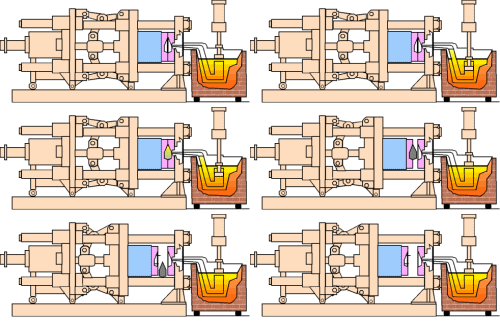
Zinc Die Casting Machine and How They Work. Die casting machines are of two basic types. One is the zinc hot chamber machines. This is also called the “gooseneck machines.” The other type is the cold chamber machines.

To feed the die, the zinc hot chamber die casting machines depend upon a pool of molten metal. At the start of cycle, the machine’s piston is drawn back and this gives way for the molten metal to fill the “goose neck.” Piston then forces zinc metal out of the gooseneck and sent to the die. This system has a fast cycling time and melting the metal in the casting machine is convenient. However, in this system, high-melting point metals cannot be utilized. Also aluminum cannot be used. Aluminum picks up iron. For this reason, hot chamber machines utilize zinc, tin and lead based alloys.

When the die casting alloy cannot be used in zinc hot chamber die casting machines, then the cold chamber machines are used instead. Among these alloys are magnesium, aluminum, copper and zinc alloys with a big composition of aluminum. The cold chamber system has a shower cycle time. This is due to the need to transfer molten metal from the furnace to the cold chamber machine.

Since cast irons cannot withstand high pressures, the dies and zinc die casting tools used in die casting are often made out of hardened tool steels. This makes dies very costly, and consequently high start up costs. There are also cores involved to cast features such as undercuts. Since they disintegrate due to high pressures, sand cores cannot be used in zinc die casting and die casting tooling. Metal cores are used instead. Wear and erosion limit a die’s life. This is strongly dependent on the molten zinc metal’s temperature.

Zinc Die Casting Tooling. The process of zinc die casting is basically one of the cheapest forming processes of metals. This process involves melting the metal into liquid so that it can be freely poured into a set of dies, or molds. The dies are held together by a clamp, subjected under high pressure until the molten metal solidifies. When the metal solidifies, the set of dies is opened and the molded shape is ejected out from the machine. This process is proven to be economical since the set of dies can be used for over a thousand times.

The industry demands different intricate and precision molded zinc parts that lead to a high demand for zinc die casting machines. Any die casting machine is dependent on its accessories and die casting tooling components. These components are those that guarantee the efficiency, capacity, and effectiveness of the die casting machine.

Die casting zinc tooling is basically the auxiliary component that is also very important in the die casting process. This component is more popularly known as a die insert, or mold. It enables the shaping or the molding of any desired part. There are a lot of standard sizes, styles, and configurations for different die inserts. They also vary in the number of cavities that can be filled in by the molten metals.

Depending on the application, die casting tooling assumes various forms. The most common form of a die cast tooling is in the form of inserts. The other forms include: prototype die cast tooling inserts, for custom made parts; unit die tooling; die cast family mold tooling; and trim dies, which are for zinc die cast parts.

Zinc Die Casting Tools: Hot Chamber Machines. Although die casting can still be created by hand, mass producing pieces for global consumption would, of course, entail the use of higher end and more efficient machines. The most prominent of die casting tools are the machines that produce several thousand pieces on a daily basis. These are the hot and cold chamber machines. Both machines serve the same functions, and one cannot really say that one is better than the other. The difference lies in the fine print. For this article, we will discuss the process of hot chamber machines and Zinc Die Casting Company.

Hot chamber machines are best suited for heavier metals, or metals that have lower melting points, or alloy that have the same properties. Molten lead is one of the best examples of such metal; as well as copper, magnesium, and zinc based alloys. These do not erode the actual components of the hot chamber machines, which makes production not only go faster, but safer as well.

The process for using these machines begins by melting the metal or alloy that is to be used in production. This is done in a huge vat that runs called the metal bath. This metal bath is attached to a gooseneck or a cylindrical metal feed system, which is eventually pumped with the molten material during processing. In turn, the gooseneck redirects some of the material into the die casting tooling die, and the material is allowed to cool within the die cavity. Once the material is solid enough, the casting die opens and automatically ejects the pieces.

Zinc Die Casting Tooling. Zinc die cast tooling has several benefits, which include long tool-life, thus it is cost-effective. It has the ability to produce very thin walls, requires no secondary machining through cast-to-print shapes, and has high tolerance.

An example of zinc die casting tooling is Inventix, a conventional tool that creates highly cosmetic zinc shift handle for the Hummer H2. Through mold flow simulation, a designer is able to create a tooling solution to meet the cosmetic challenge. Secondary operation is eliminated because of high-precision and flash-free zinc die casting.

Through zinc die casting tooling, a company will be able to produce product fitted to the desire of the customer. To produce an intricate zinc key cylinder within budget, a company uses Inventix with an additional 5th and 6th slide position to a 22NT Techmire die cast zinc part.

The tool design includes an extremely in-die degating and tight-tolerance blade design. To eliminate the need for secondary operations the design engineers incorporate two cavities within the tool to boost production. Zinc parts need trim tooling called trim die, which is used to remove the unnecessary zinc surrounding the zinc parts. This process involves placing the alloy into a press with hydraulic forces with enough pressure. Zinc die casting molds, zinc die casting dies, or insert dies are other terms for zinc die casting tooling. It comes in different shapes, styles, and sizes. The price depends on the trim dies and cavity inserts. By employing die cast zinc tooling, as much as 15% of the price can be saved.