Posts Tagged ‘Miniature Zinc Parts’
Die Casting Technology - Miniature Zinc Castings
The technology of Zinc Die Casting has developed so much in just few years after it was introduced in public. It has contributed a lot in the industry of miniaturization. Now, even the smallest and the most complicated geometrical parts of the zinc can be die casted through a remarkable correctness, as well as several features like multiple cored-through holes, flash-free sculpted shut-offs, very thin walls and formed shapes. A process that is used to create zinc miniature is called Miniature Zinc Castings.
Miniature Zinc Die Castings is an accuracy manufacturing method, which offers cost-effective production, repeatability and accuracy, improved material properties, complicated geometries and design adaptability. The Miniature Zinc Castings method is particularly useful as a substitute for assembly, stamping and screw machining.
You will be surprised to know that it can only take one pound of modern zinc alloy to create 17,000 completed castings of zinc miniatures. Modern zinc alloy is definitely tougher and stronger than magnesium or aluminum and it provides better flexibility. Zinc parts can be created in smaller sizes, along with greater complication and finer element. The best thing about zinc is that it can be easily painted and plated in addition to the wide-variety of metals to give a scope of finish and feature selections.
There are many benefits that the Miniature Zinc Castings method gives to the users and component designers aside from providing a low-cost of component. Other benefits are finishing uniqueness and exceptional exterior quality, pleasant substantial properties, thin wall divisions, great mechanical properties and low-cost assembly.
Miniature Zinc Aluminum Castings. Zinc aluminum die casting is ideal in many cases because of the low production cost involved and the high-quality output produced. It is best applied when producing small to medium parts. The same principle is applied in miniature zinc castings. Zinc casting performs better as it has good mechanical and physical properties.
The most important characteristic that miniature zinc aluminum die casting must posses is precision. Miniature zinc aluminum die castings involve small parts. Precision in terms of detail is important at all times. Otherwise, the miniature zinc aluminum die castings will not properly perform its purpose and may render the entire equipment/machine unfit for use.
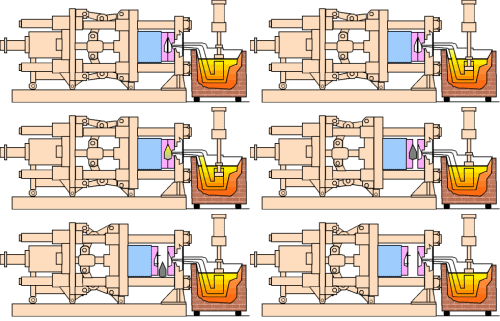
The entire process in producing miniature zinc aluminum die casting takes place just like most common zinc die casting processes begin. The zinc is heated until it becomes molten or in its semi-liquid state. What sets miniature zinc castings apart from the usual zinc die casting process is that the former makes use of precise details. Using a 4-slide mold, the outputs produced in the procedure weighs from less than an ounce to a quarter of a pound. A wide variety of zinc alloys can also be used in the process. Sometimes, zinc-aluminum alloy is used. ZA8, ZA12 are common Zinc Aluminum Alloys.
Miniature zinc castings are used to produce small but durable and precise zinc parts. These zinc parts are often used in sporting goods, medical equipments, household tools and appliances, telecommunications, electronics and automotives. The options are endless. With its low cost production and yet durable product, miniature zinc casting is indeed an important process in any production industry.
The Techmire Zinc Castings Machines
The Techmire zinc die casting machine is a multiple-slide zinc die casting machine that is capable of producing small, complex and intricate zinc castings at minimum cost. Having the capacity to produce tiny and precision zinc die castings, small zinc parts, this makes Techmire zinc castings the global leader in the industry of designing and fabricating multiple-slide zinc die casting machines.
Techmire is one of the leaders in the metalworking industry today. It was founded in the year 1983 in Montreal, Canada. You will now find Techmire machines in about more than thirty countries all over the world. Techmire zinc casting machines are specifically designed for zinc. Techmire has two sets of machines. They are the NT series and the NTX series. The NT series machine uses the multiple-slide technology, being fully automatic, hot chamber and has high precision. The NXT series is an improvement of the NT series. It has the latest technology that can handle higher capacity and extreme pressures. End products of NXT series machines have better surface finish and greater part density. The NT series have three models. They are the 22 NT, the 44 NT and the 66 NT. These three machines differ in nominal die size and shot weight.
Techmire’s largest die casting machine is the 88 NTX. It has a dry cycle speed of 2,100 cycles per hour and it has a quick die-changing capability allowing change over of two-slide molds. This machine is designed for single-cavity production of large area or multiple-cavity production of small components. All NTX models offer improved functions for different ranges of products.
Miniature Type of Zinc Castings
Zinc die casting is very popular among those who are in the die casting industry. Zinc is very good die casting material because of its properties. A lot of products come from zinc die casting, including golf clubs, automotive parts and hardware parts. One type of zinc die casting is the miniature zinc casting process. Miniature parts zinc castings are made with the use of a 4-slide die casting mold. The weight of production processes range from a fraction of an ounce to as much as ¾ lbs with sizes from miniscule to 4 x 4 x 1 inch. Miniature zinc casting parts can undergo die casting in a complete range of zinc alloys like Zamak 2, Zamak 3, Zamak 5 and Zamak 7. ZA-8 zinc-aluminum alloys can also be an option. Zamak is another name for Zinc.
The main reason why manufacturers use miniature zinc casting is because miniature zinc parts can undergo faster cycling and can be made on multi-slide hot chamber zinc die casting machines. Miniature zinc die casting machines have proven this new technology as the choice for highly sophisticated miniature zinc casting components. Although the technology of high-precision miniature zinc die casting process is very much alike, the hot chamber zinc die casting process of bigger zinc part types, the former is able to hold higher tolerances, usually with zero draft to “net shares” or “as cast” in faster cycles.
Zinc and ZA8 parts are developed by reducing the metal shrinkage and removing operations of pre-die casting. Automated production of zinc parts can make miniature zinc casting parts and units attain a value of pennies per piece and with tremendous low tooling investments. Plus, the lifespan of your projects can endure longer time when you use miniature zinc and ZA-8 die casting tooling.
The Advantages of Using Miniature Zinc Die Castings. Die cast parts, also known as die cast tooling, can be made using different metals and their alloys. This makes the die casting process versatile. Metals and the alloys that can be used in the die casting process can be turned into die cast parts through the employment of hot chamber casting or cold chamber casting. Either way, die cast parts can come out bearing excellent quality. Some of the most preferred materials are zinc and its alloys. There are now several die casting companies that use zinc; the popularity of the zinc die casting process over all other casting processes has greatly increased since its introduction in 1914. Over the years and with the advancements in technology, both large and miniature zinc castings have become easier to create.
Since cast components are used in various applications that are prone to heat, truly helpful features that zinc die cast parts have is heat resistance and corrosion resistance. They can also be secured tightly than other cast parts. This is because die cast parts in general do not have welded or fastened separate parts. Die cast parts can be made in different sizes and shapes. Some people might have the notion that smaller and more complicated die cast parts are harder to make, but this actually is not a problem, thanks to the maneuverability of the die casting process. Miniature zinc die castings can be mass produced without much difficulty in manual labor. In some cases, machine assistance to provide finishing touches for miniature zinc castings and other die cast parts is not required at all, cutting down post-production expenses effectively.