Posts Tagged ‘Metal Cast Parts’
Advantages of Zinc Metal Cast Parts Types. Unknown to most people, the die casting process has been around for over a century, but it was only in modern times that the process gained heavy recognition, preference and patronage. These days, you can find billions of die cast components being sold in different parts of the world. Manufacturers of die cast parts find it important to choose the right metal and alloys. Some of the most popular die cast products out there are zinc metal cast parts types.
There are many reasons why said manufacturers choose to produce zinc parts types. As the material with the lowest production cost, zinc is a favorite among die cast materials; zinc alloys both have strength and hardness, making them ideal alternatives to pressed, machined, stamped, and fabricated parts. As opposed to other alloys also used in die casting, zinc alloys have first-rate electrical conductivity and thermal conductivity, exceptional dimensional accuracy, stability, and quality finishing properties. They are also very resistant to corrosion and can be joined easily because of their ability to succumb to cold form. More importantly, they have can be recycled in full – a characteristic that is held in high esteem today because of the environment’s present deteriorating state. Zinc metal parts types can be used in various industrial applications in today’s world. For example, electronic connectors – and even chassis, frames, and shields used in computing equipment and handheld telecoms – can be enhanced to give notable shielding properties and overall excellent electrical performance through the employment of complex, net-shaped zinc housings that have thin, precisely measured walls.
Zinc Parts Die Casting Process. The process of die-casting is a common forming process for most metals. This is a casting method, which employs the use of dies for molding to be done. The casting method is employed when no other practical means of forming the metal is applicable. This is denoted when any of the following conditions are observed: when the desired product or shape is too large for other practical processes; when properties such as strength and quality are not very important considerations; and when the alloying metal incorporated has very low ductility making hot working or cold working hard to employ.
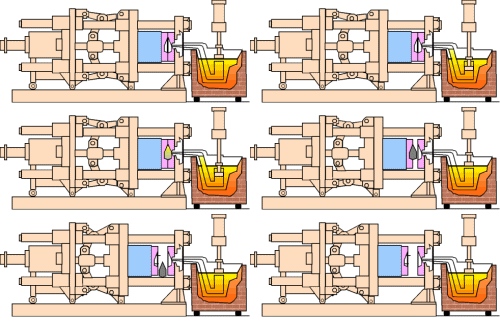
For practical and economical reasons, the zinc die casting process is considered in most industrial applications, specifically in the automobile industry, where zinc is widely used. In the zinc die casting process, the zinc metal is prepared for melting inside the furnace, where the melting temperature is achieved. The zinc has to be melted in such a way that it assumes the liquid state. The molten metal is then poured at a high velocity into a set of metal dies, which are maintained at a certain pressure. The metal is then allowed to cool until it completely solidifies within the die. When complete solidification is ensured, the dies are opened, and the molded zinc metal casting is removed.
The zinc die casting process is proven to be cost effective and economical over the other forming processes of metals, most especially when it requires the molding of large parts, and when strength is not of utmost consideration.
Zinc Die Casting Parts Types. The process of zinc die casting is the casting of zinc into the desired size and shape with the use of a set of dies. This method of die casting is considered economical and really cost effective. Any desired product specification can be achieved through this process. Basically the zinc die casting process is focused on the production of the much larger size rather than precision parts, but its venture into the production of precision parts has found a great deal of importance in the manufacturing industry.
There are different products that are fabricated and produced from the zinc die casting method, which are commonly and popularly called as zinc die casting parts types. These products vary in size and shape. Some are small intricate parts, while some are of larger sizes. These parts are produced for various industrial applications. Some are used as automotive castings, bathroom faucets, handles, hooks, decorative hardware, carburetors, and even covers. Indeed, there are probably thousands of other zinc die casting parts types that have been established globally.
A lot of companies all over the world are involved in the manufacture of these various zinc die casting parts types. There is probably an equal number of companies that are involved in the production of intricate and precision parts, but more and more companies are geared towards the production of the larger zinc die casting parts types. For ease and convenience in looking for different zinc die casting parts, a buyer’s directory, which contains registered importers and exporters, as well as purchasers and resellers, is available.
Zinc Electrical Parts. A great number of small and medium sized metal parts comprising most electrical and electronic equipment are made of zinc. These zinc die casting parts are popular choices in the production of various electrical and electronic equipment. Zinc parts boast of strength and hardness not always present in parts that are plastic molded, sand casted, permanent mold casted, forged, stamped, and screw machined. Zinc material advantages especially in the electrical industry are resistant to temperature extremes and have superior electrical properties.
These zinc die casting parts are efficient both in terms of cost and functionality. Cost efficiency is one of the zinc material advantages because zinc parts can be manufactured in one single piece of multiple components. This eliminates the need for later assembly or for additional fastening implements. Furthermore, this results in more durable parts that rely more on the strength of its material rather than in the strength of the fastening material used or the way the parts are joined together. The durability of the zinc die casting parts spell their efficiency in terms of their use and function.
Zinc die casting parts also have excellent shielding properties that allows it to function in internal circuits as an electrical ground. These metal parts have high thermal conductivity that makes them fitting choices for electronic connectors as well as small components in consumer electrical and electronics equipment. The added benefit of the zinc die casting parts’ finishing versatility also allows for wear resistance in when used as external parts of various implements. These zinc material advantages make zinc die casting company parts an efficient choice in most electronic and electrical applications.
How to Make Zinc Die Casting Parts. You have probably heard about zinc cast parts, some of the most important elements that make the metalworking industry more reliable and profitable than ever. Zinc cast parts are made through the practice of the zinc die casting process. Basically, the said process forces molten zinc metal under pressure that is high, right into die casting tooling cavities, in order to form cast parts. This process is also referred to as the die casting process and, in some cases, may use another metal other than zinc. Both ferrous and non-ferrous materials can be used, such as zinc, tin, lead, and magnesium, to name some of them. For purposes of this article, however, zinc as the main material will be discussed.
The zinc die casting process, which is a very tedious one, can produce zinc cast parts that are small to medium in size. As for their appearance, cast parts made from zinc are known to carry intricate, impressive details, as well as delicate and finely textured surfaces. What is most notable about he said process is its consistency as far as the dimensions of the cast parts are concerned.
In order to make zinc die casting parts that are of high quality, zinc part castings need not be expensive. One of the benefits that the metalworking industry appreciates about the process is that it is very economical. Production costs are kept to a minimum because the parts only need the primary equipment. Zinc Die Casting Tooling and screening afterward are rarely required. The process to make zinc die casting parts involves just a few additional things, namely injections, lubricants, and cooling tools.