Posts Tagged ‘Metal Cast Parts’

Die Casting – Different Zinc Parts Types. The Zinc Die Casting has been very popular around the world for a very long time simply because it gives lots of benefits. Additionally, the three methods of Zinc Die Casting make various Zinc Parts Types.

The first and the oldest Zinc Die Casting method is the customary die casting. This method creates Zinc Die Cast Parts which have the most remarkable fine veneer and maximum tolerance. Die Casting Method is suggested for the creation of tiny to average Zinc Die Cast Parts.

The second method called Sand Casting is suggested to be used for the creation of big Zinc Die Cast Parts which need unrefined surface.

The gravity-fed casting is the third method of Zinc Die Casting parts. It is the most common choice that’s why it is mostly used for the creation of Zinc Parts Types in any sizes.

Nowadays, many industries have been using Zinc Parts Types out of Zinc Die Castings. At times, golf clubs and zinc automotive parts are made with the use of zinc die casting method in addition to zinc home hardware parts like zinc lock cases which are used for security system.

Here is a list of the few Zinc Parts Types that are used in our everyday lives:

    1. Fishing lures
    2. Golf club putters
    3. Pump valves
    4. Pumps
    5. Pump handles
    6. Pump rotors
    7. Power tools
    8. Zinc door knobs
    9. Kitchen hardware
    10. Frames and cases
    11. Heat sinks
    12. Handles, Door handles
    13. Motorcycle grips
    14. Flanges
    15. Faucets
    16. Fire alarm case
    17. Die-cast toys
    18. Die cast cars
    19. Carburetors
    20. Hooks

Die Casting Technology - Miniature Zinc Castings

The technology of Zinc Die Casting has developed so much in just few years after it was introduced in public. It has contributed a lot in the industry of miniaturization. Now, even the smallest and the most complicated geometrical parts of the zinc can be die casted through a remarkable correctness, as well as several features like multiple cored-through holes, flash-free sculpted shut-offs, very thin walls and formed shapes. A process that is used to create zinc miniature is called Miniature Zinc Castings.

Miniature Zinc Die Castings is an accuracy manufacturing method, which offers cost-effective production, repeatability and accuracy, improved material properties, complicated geometries and design adaptability. The Miniature Zinc Castings method is particularly useful as a substitute for assembly, stamping and screw machining.

You will be surprised to know that it can only take one pound of modern zinc alloy to create 17,000 completed castings of zinc miniatures. Modern zinc alloy is definitely tougher and stronger than magnesium or aluminum and it provides better flexibility. Zinc parts can be created in smaller sizes, along with greater complication and finer element. The best thing about zinc is that it can be easily painted and plated in addition to the wide-variety of metals to give a scope of finish and feature selections.

There are many benefits that the Miniature Zinc Castings method gives to the users and component designers aside from providing a low-cost of component. Other benefits are finishing uniqueness and exceptional exterior quality, pleasant substantial properties, thin wall divisions, great mechanical properties and low-cost assembly.

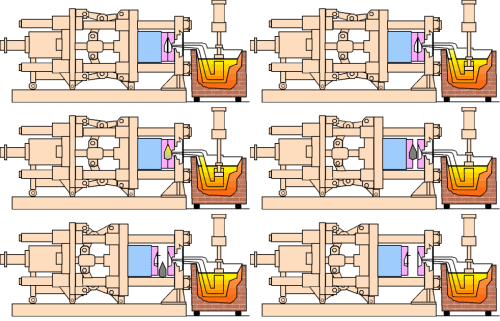
The Process of Hot Chamber Zinc Die Castings. A Hot Chamber machine is especially used for low melting point alloys like magnesium, zinc and copper, which don’t quickly damage metal hot chamber pots, plungers and cylinders. One popular hot chamber die casting process used is the Hot Chamber Zinc Castings process. Because it provides high rate of productivity, more and more companies are using the Hot Chamber Zinc Castings process.

In the process of Hot Chamber Zinc Die Castings, strips or rods of metal zinc will be melted inside a hot chamber at about 700-800 degrees Fahrenheit. While the zinc metal is inside the hot chamber, the gooseneck, commonly called as the shot sleeve, will be plunged into the hot chamber. Then the molten zinc metal is injected straightly from the hot chamber, inside the pair of die halves that are attached in the Hot Chamber Zinc Die Castings machine.

After that, the molten zinc metal will be infused with hydraulic pressure inside the pair of die halves. The molten zinc will be held under a high pressure in anticipation of the solidification of the metal. The waiting time is commonly about 15 seconds, but it still depends on the size of the parts. Afterwards, the pair of die halves will be opened and all the parts will be removed either by hand or with the use of a machine. Finishing touches like assembly, chrome plating, anodizing, painting, precision machining, tumble deburring and trimming will be followed.

That’s how the process of Hot Chamber Zinc Die Castings works. It may look simple but it requires regular monitoring and hard work to produce a perfect material.

Zinc Die Casting Process is Direct Injection Zinc Die Casting for Cast Metal Parts. The zinc die casting process involves heat, pressure and of course, zinc to produce metal castings. With the help of machines especially designed to apply and handle these three elements, when combined together produces zinc dies. The machine used in the zinc die casting process is the hot-chamber machine.

The zinc metal die casting process begins when zinc is placed on a very high temperature. The high temperature is then absorbed by the zinc. The zinc becomes soft and malleable. While the zinc is at its malleable state, it is shot at high pressure (usually 1,500 to 25,000 psi.) into the die. The die is lubricated beforehand. The lubrication in the die has a two-fold purpose. First, the lubricant enables the zinc to be easily removed from the mold. Second, it allows the temperature in the mold to be easily controlled. Upon injection of the heated zinc, pressure is then applied to the mold until the soft zinc solidifies.

Direct-injection die casting is also used in the zinc die casting process. Also known as runner-less die casting, this procedure is employed in zinc die casting as it has many advantages. It has slower cooling cycles which enables it to produce better results. The cost of using this process is also cheaper as it does not use much energy.

Zinc die casting is preferred by many industries. This is because zinc is the metal which is the easiest to cast but still produces great outputs. It works well on small areas and lasts a long time.

Why Zinc Parts Die Casting Process. The zinc die casting process gives way to the production of zinc die cast parts, which are made of zinc or zinc alloy tool steels. They each may have at least two sections, namely the cover half, also known as the fixed die half, and the ejector die half; these sections allow the easy removal of the castings from the machines. The ejector die half is what contains the passageways and inlets, all of which prod the molten metal to enter the cavity. Today, zinc die cast parts may also have movable cores, slides, and other sections in order to make various shapes. They also have locking pins that work to secure the two sections; openings for cooling and lubricating purposes; and ejector pins that are designed to help take out the cast parts.

During that part of the zinc parts die casting process wherein the machine closes, the two die sections are secured and held tightly together by the hydraulic pressure of the machine. The ejector die half and the fixed die half meet together and become locked in at a projected surface area called the die parting line. The clamping force of the die casting machine is governed by the total projected surface area of the part being cast and the hydraulic pressure required for the said machine to inject the zinc metal or zinc alloy into the cavity. These days, die casting machines have the ability to load 250 tons to 1,600 tons, setting the annual production capacity of companies employing the zinc die casting process in 400 sets-molds and at least 20,000 zinc die cast parts.