Posts Tagged ‘Die Casting Tooling’
Hot Chamber Zinc Castings. The die casting process has become widely popular over the decades. Since a patent was granted to Sturges in 1849, the die casting process has gained patronage from all parts of the industrialized world. Today, there are hundreds upon hundreds of companies that manufacture and sell die cast parts, which are also referred to collectively as die cast tooling. Die cast parts, as known by many, can be created using different materials. The first ones introduced were tin and lead, but the birth of zinc die cast parts in 1914 saw the beginning of a new era in the die casting community. Although copper and aluminum soon followed, zinc and its alloys, whether for hot chamber zinc castings or cold chamber zinc castings, were and still are the favorite die casting materials.
The die casting process in its most basic state consists of injection molten metal into a die (a steel mold) under high pressure. Die casting machines come in various sizes; they are usually rated in clamping tons which are the equivalent of the amount of pressure they will be able to exert on the die or steel mold. But whether a machine is sized at 400 tons or 4,000 tons, the main difference lies in the method employed for the injection of the molten metal into the die casting tool or steel mold. There are two methods available, namely the hot chamber method and the cold chamber method. As far as the zinc die casting process is concerned, hot chamber zinc castings are more popular than cold chamber zinc castings. Hot chamber zinc castings can be produced in less than one second to over two or three minutes, depending on their weight.
Zinc Die Casting Tooling. The process of zinc die casting is basically one of the cheapest forming processes of metals. This process involves melting the metal into liquid so that it can be freely poured into a set of dies, or molds. The dies are held together by a clamp, subjected under high pressure until the molten metal solidifies. When the metal solidifies, the set of dies is opened and the molded shape is ejected out from the machine. This process is proven to be economical since the set of dies can be used for over a thousand times.
The industry demands different intricate and precision molded zinc parts that lead to a high demand for zinc die casting machines. Any die casting machine is dependent on its accessories and die casting tooling components. These components are those that guarantee the efficiency, capacity, and effectiveness of the die casting machine.
Die casting zinc tooling is basically the auxiliary component that is also very important in the die casting process. This component is more popularly known as a die insert, or mold. It enables the shaping or the molding of any desired part. There are a lot of standard sizes, styles, and configurations for different die inserts. They also vary in the number of cavities that can be filled in by the molten metals.
Depending on the application, die casting tooling assumes various forms. The most common form of a die cast tooling is in the form of inserts. The other forms include: prototype die cast tooling inserts, for custom made parts; unit die tooling; die cast family mold tooling; and trim dies, which are for zinc die cast parts.
Zinc Die Casting Tooling. Zinc die cast tooling has several benefits, which include long tool-life, thus it is cost-effective. It has the ability to produce very thin walls, requires no secondary machining through cast-to-print shapes, and has high tolerance.
An example of zinc die casting tooling is Inventix, a conventional tool that creates highly cosmetic zinc shift handle for the Hummer H2. Through mold flow simulation, a designer is able to create a tooling solution to meet the cosmetic challenge. Secondary operation is eliminated because of high-precision and flash-free zinc die casting.
Through zinc die casting tooling, a company will be able to produce product fitted to the desire of the customer. To produce an intricate zinc key cylinder within budget, a company uses Inventix with an additional 5th and 6th slide position to a 22NT Techmire die cast zinc part.
The tool design includes an extremely in-die degating and tight-tolerance blade design. To eliminate the need for secondary operations the design engineers incorporate two cavities within the tool to boost production. Zinc parts need trim tooling called trim die, which is used to remove the unnecessary zinc surrounding the zinc parts. This process involves placing the alloy into a press with hydraulic forces with enough pressure. Zinc die casting molds, zinc die casting dies, or insert dies are other terms for zinc die casting tooling. It comes in different shapes, styles, and sizes. The price depends on the trim dies and cavity inserts. By employing die cast zinc tooling, as much as 15% of the price can be saved.
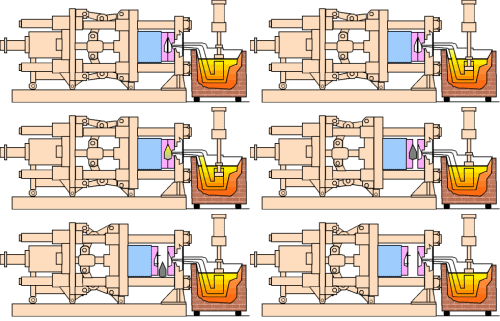
Hot Chamber Zinc Castings. The process of hot chamber zinc casting is a process that melts zinc using a 700- to 800-degree Fahrenheit furnace. Once the zinc is liquefied, it stays in the heat. A sleeve is placed in the heat and injected to the molten zinc metal, which is held together by the machine directly from the furnace into the two die halves.
The two halves of the die casting tooling are placed on the machine that keeps the two halves together and remains closed until the next step. Hydraulic pressure solidifies the metal within two to seconds depending on the size of the parts. After this the part is removed and ejected by hand or robotically, the halves are then opened. Trimming, precision machining, tumble deburring painting, chrome plating, anodizing, and assembly will follow.
The hot chamber zinc die castings is intended for zinc, copper, lead, magnesium and others on alloys with low melting point. The process does not destroy and erode metal furnace pots, plungers, and cylinders. The injection mechanism of hot chamber zinc casting machine is done by immersing zinc in the molten metal bath of a metal holding furnace. A port in the injection cylinder opens and the injection cylinder plunger rises, allowing the molten metal to fill the cylinder. One of the advantages of hot chamber zinc diecasting is the fast cycle-time and the easy steps of melting in the casting machine. Disadvantages of this system include the high-melting point metals that cannot be utilized. What’s mote, aluminium is not suited for this system because it picks up some of the iron while in the molten pool.
Zinc Die Castings. A process in which alloys are forced to melt using high pressure and molded into steel, which is reusable is called die casting. These dies are molded to create shapes with great degree of repeatability and accuracy. It is best for different variety of serviceable and attractive finishes. Its parts are defined sharply, with surfaces that are textured or smooth.
Among the list of alloy to cast, zinc is the easiest. It has high impact strength, and high ductility that can be easily plated. The Zinc die casting is cheaper for small parts. It promotes long die casting tooling life and also has low melting point.
The first die casting started in mid 1800s using the alloys tin and lead. The process is done by injecting a pressure. The patent for machine used in printing type cast, which is operated manually was awarded to Sturges in 1849. In 1914, the use of tin and lead in die casting has reduced with the birth of aluminium and zinc alloys. Since then zinc die casting has become the famous die casting in the world. Hot Chamber zinc die casting as compared to aluminium die casting requires greater heat since aluminium has a great strength at high temperatures. Unlike zinc, aluminium is a lightweight alloy, with high dimensional stability for complex shapes and thin walls. Zinc is the easiest to cast so it became the most sought-after alloy in the industry of engineering.
Die casting process is economical and efficient as compared to other manufacturing processes that offer a broad range of components and shapes. It is designed to compliment different parts and have longer service life parts. The designers using die cast can gain number of benefits and advantages.