Archive for the ‘Zinc Alloys’ Category

Characteristics of Die Casting Zinc Alloys. Different types of zinc alloys are commonly produced by the Zinc Die Casting process. Zinc alloys are applicable for broad variety of products due to excellent impact strength and high flexibility. Die Casting Zinc Alloys may be cast with thin walls and outstanding surface sleekness, which makes the preparation for painting and plating somewhat simple. In the generation of alloys, it is important that you use high-purity zinc metals. The dimensional stability and lasting integrity of the alloy’s toughness is guaranteed through low limits on cadmium, lead and tin.

These are the different characteristics of Die Casting Zinc Alloys:

    1. Excellent corrosion resistance
    2. 100% recyclable
    3. High-quality finishing attributes
    4. Has the capability to cold form that eases joining
    5. Raw materials are inexpensive
    6. High thermal and electrical conductivity

Another characteristic of Die Casting Zinc Alloys is its low melting point. This characteristic makes the zinc alloy sufficiently flexible in order to use it for cold chamber casting equipment and hot chamber casting equipment. Even the ZA Alloys work well in most equipment.

Die Casting Zinc Alloys rigidity and high strength makes it the perfect substitute to fabricated, stamped, pressed and machined items. The complicated net-formed zinc casings with exact thin walls provide exceptional shielding properties and electrical performance to electronic connectors, chassis, shields as well as frames for hand-held telecom and computing equipment. The small and complex elements of Die Casting Zinc Alloys are used in several electronics and consumer electrical applications such as shutter devices in cameras, heat sinks, precision interlocking gears, hard disk drives, portable computers and mobile phone antennas.

Miniature Zinc Aluminum Castings. Zinc aluminum die casting is ideal in many cases because of the low production cost involved and the high-quality output produced. It is best applied when producing small to medium parts. The same principle is applied in miniature zinc castings. Zinc casting performs better as it has good mechanical and physical properties.

The most important characteristic that miniature zinc aluminum die casting must posses is precision. Miniature zinc aluminum die castings involve small parts. Precision in terms of detail is important at all times. Otherwise, the miniature zinc aluminum die castings will not properly perform its purpose and may render the entire equipment/machine unfit for use.

The entire process in producing miniature zinc aluminum die casting takes place just like most common zinc die casting processes begin. The zinc is heated until it becomes molten or in its semi-liquid state. What sets miniature zinc castings apart from the usual zinc die casting process is that the former makes use of precise details. Using a 4-slide mold, the outputs produced in the procedure weighs from less than an ounce to a quarter of a pound. A wide variety of zinc alloys can also be used in the process. Sometimes, zinc-aluminum alloy is used. ZA8, ZA12 are common Zinc Aluminum Alloys.

Miniature zinc castings are used to produce small but durable and precise zinc parts. These zinc parts are often used in sporting goods, medical equipments, household tools and appliances, telecommunications, electronics and automotives. The options are endless. With its low cost production and yet durable product, miniature zinc casting is indeed an important process in any production industry.

Die Casting Zinc Alloys Zamak. Zinc alloy is preferred by most people in the metal making industry especially in die casting for many reasons. The most popular of the reasons is the fact that zinc has a low melting point. It means that it does not require a very high temperature in order for it to turn into its liquid state. This characteristic makes it easier to be casted.

Another reason why zinc alloy is preferred is that this metal is durable and takes a long time before it actually deteriorates. It is highly ductile and can be casted into different shapes and sizes. It can withstand huge amounts of pressure. However, in order that such qualities of zinc be retained, it is necessary that the other metals mixed with it are limited. Hence, other metals such as lead and tin must be used in moderation.

These outstanding characteristics of die casting zinc alloys made it a top choice of producers in many industries such as automotive, medical equipments and household appliances.

Die casting zinc alloys are not only limited to a single type. Zinc alloys are also known as Zamak in the industrial world. Zamak is an acronym that stands for zinc, aluminum, magnesium and copper. Zinc comes in various types with different levels depending on the output desired. Die Casting Zinc Alloys are classified as Zinc #2, Zinc #3, Zinc #5, and Zinc #7. The other classification of zinc alloy is ZA or the zinc-aluminum alloy. It is further classified into ZA-8, ZA-12, and ZA-27.

Advantages of Die Casting Zinc Alloys. Die casting is a process that has quickly earned worldwide preference in the industrial community over the last few decades. The process has proved itself to be more efficient, economical, and quality-oriented as opposed to other casting processes out there. This is why there are now more die cast parts being sold than any other cast parts. One of the most important things to consider in the die casting process is the material to be used. In this aspect, zinc alloys are certainly some of the most popular choices. Die casting zinc alloys provide manufacturers and their customers alike with various advantages, which this article will briefly point out.

First of all, die casting zinc alloys are not as expensive as other alloys available. In fact, they are the cheapest materials as far as production (and post-production) costs in the die casting process are concerned. This is because they zinc alloys have excellent finishing properties that make them ready for selling even without undergoing polishing from tooling machines. Part consolidation eliminates further operations. Zinc is also the easiest alloy to cast. Zinc alloys all have high impact strength and ductility. They give consistent quality even when created in large volumes, resulting in the long life of the die molds used and the cost-effectiveness of all production stages. Die casting zinc alloys also require only minimal draft angles on their internal features so that their collective unit price is lower, bringing much financial convenience to both the manufacturers and the consumers.

New Die Casting Zinc Alloys. Zinc is a metallic element that is very malleable and can easily be formed into shapes. It can also be alloyed with a lot of different other metals. The alloying of zinc with other metals enables the alloys to possess certain characteristics and properties that make them indispensable in the industrial world.

The most common alloy of zinc is that with copper, or what is more popularly known as brass. It has a wide range of uses including the manufacture of coins, kitchenware, and even hardware for corrosion-resistance. Other important alloys are tin, lead, nickel, and aluminum. All these different alloys of zinc have found importance in different fields of the industry as well.

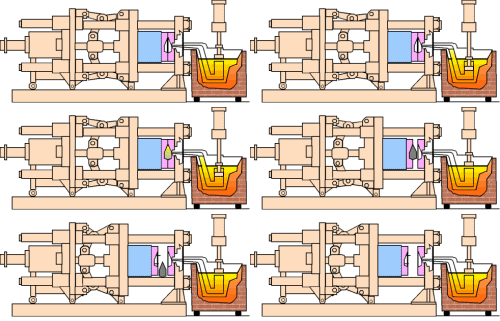
The most common forming process of these alloys is die casting. In die casting zinc alloys, zinc and the other metals are melted in a large furnace with the objective of achieving the melting temperatures for these zinc alloy metals. As the metals melt, the liquid is poured over the dies, which are clamped together until the metals solidify. When the metals solidify into the desired shape, they are ejected out of the dies. In some cases, the metals are just taken out of the dies manually.

In die casting zinc alloys, it actually just follows the usual process of die casting, only that the melting temperatures of the alloys should be taken into consideration in order to achieve a temperature that works for all alloying components. Die casting zinc alloys into precision parts is one of the most popular demands in the industry today. Linkedin