Archive for the ‘Hot Chamber Zinc’ Category

The Process of Hot Chamber Zinc Die Castings. A Hot Chamber machine is especially used for low melting point alloys like magnesium, zinc and copper, which don’t quickly damage metal hot chamber pots, plungers and cylinders. One popular hot chamber die casting process used is the Hot Chamber Zinc Castings process. Because it provides high rate of productivity, more and more companies are using the Hot Chamber Zinc Castings process.

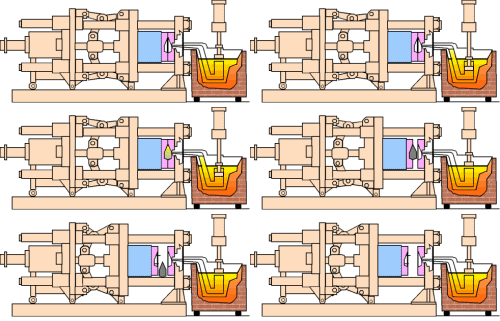
In the process of Hot Chamber Zinc Die Castings, strips or rods of metal zinc will be melted inside a hot chamber at about 700-800 degrees Fahrenheit. While the zinc metal is inside the hot chamber, the gooseneck, commonly called as the shot sleeve, will be plunged into the hot chamber. Then the molten zinc metal is injected straightly from the hot chamber, inside the pair of die halves that are attached in the Hot Chamber Zinc Die Castings machine.

After that, the molten zinc metal will be infused with hydraulic pressure inside the pair of die halves. The molten zinc will be held under a high pressure in anticipation of the solidification of the metal. The waiting time is commonly about 15 seconds, but it still depends on the size of the parts. Afterwards, the pair of die halves will be opened and all the parts will be removed either by hand or with the use of a machine. Finishing touches like assembly, chrome plating, anodizing, painting, precision machining, tumble deburring and trimming will be followed.

That’s how the process of Hot Chamber Zinc Die Castings works. It may look simple but it requires regular monitoring and hard work to produce a perfect material.

Die Casting Processes with the Use of Zinc Alloy. Die casting is the process by which molten ferrous metal, e.g., zinc, magnesium, copper, lead, tin, aluminum, etc., are molded into cavities and placed under pressure to form. The method of die casting is ideal if the application needed is in large quantity and should be well-detailed and has fine quality. Zinc is a non-ferrous metal that is popularly used for die casting. This is due to the fact that zinc alloys have many characteristics that far exceed other metals. Zinc alloys have high strength and hardness, has high thermal and electrical conductivity, low cost, good finishing characteristics, outstanding fluidity, and excellent corrosion resistance among others.

In the zinc die casting process, two processes are involved, the hot chamber method and the cold chamber method. These two zinc die casting processes make use of various types of metal alloys during the production of parts in the zinc die casting process. The hot chamber method involves the process wherein a steel die is filled with a pool of molten metal, all the time maintaining pressure, until the metal hardens. The second process, the cold chamber method, involves the use of two separate chambers, first to melt, then to hold the melted zinc alloy before it is poured into a shot cylinder and afterwards inject them to the die casting die. Before, the metal alloys used in Zinc die casting processes are tin and lead. The zinc alloy however gained popularity and is now the first choice when it comes to die casting.

Hot Chamber Zinc Castings 800 degrees Fahrenheit. The most ideal machine used in zinc die casting is the hot chamber. Hot chamber zinc casting is the common method used in zinc because it does not require a very high temperature in order to melt the metal. Metals with high-melting point such as aluminum do not do well in hot chamber casting. There is a tendency that the metal will absorb the iron in the machine. Hot chamber die casting is used in other alloys that have low-melting point such as copper and magnesium.

The process in hot chamber zinc die casting begins with melting the slabs of zinc in the furnace. In order for zinc to reach its melting point, heat must be approximately 700-800 degrees Fahrenheit. As soon as the zinc reaches its melting point and turns liquid, it is then displaced through a shot sleeve. Known as the goose’s neck, the sleeve is dipped in the furnace and then injected into the die. Pressure is applied until the zinc returns to its solid state while retaining the shape of the die cast. To make the casting process easier, lubricants are applied to the mold. This helps the removal of the molded zinc as well as the control of the temperature easier. In some instances, robotics is employed to remove the molded metal. The solidification process usually takes 2-15 seconds.

Other operations after the hot chamber zinc casting are performed to polish the molded metal. Such operations include trimming, painting and plating. This makes the details of the casted zinc more precise and functional.

A Brief Overview of the Zinc Die Casting Process. There is no question about it: When it comes to casting methods, the die casting process tops the list. It is a favorite not only among companies engaged in the manufacturing and selling of cast parts but also among consumers engaged in businesses that require the use of heavy-duty die cast components. There are different materials that can be used in the die casting process. These include metals such as aluminum, magnesium, copper, tin, and the crowd favorite – zinc. Because of this, the zinc die casting process is one of the most preferred die casting processes these days.

So, what actually happens in the zinc die casting process? Once the material is chosen – that is, once zinc has been selected, it is turned into molten metal and then injected under high pressure into a die, which is what die casters generally call a steel mold. The size of the die casting machine will depend heavily on the pressure needed to be placed on the die; this ranges from 400 tons to as much as 4,000 tons. A complete zinc die casting cycle may last for as fast as less than a second or to a couple of minutes; the desired size of the product will be taken into consideration. Naturally, components that weight less than one ounce can be created quicker than those that weigh several pounds or more. This is why for companies that make non-ferrous parts, a task that can take many hours with other casting methods, the zinc die casting process proves more advantageous.

Zinc Die Casting Machine and How They Work. Die casting machines are of two basic types. One is the zinc hot chamber machines. This is also called the “gooseneck machines.” The other type is the cold chamber machines.

To feed the die, the zinc hot chamber die casting machines depend upon a pool of molten metal. At the start of cycle, the machine’s piston is drawn back and this gives way for the molten metal to fill the “goose neck.” Piston then forces zinc metal out of the gooseneck and sent to the die. This system has a fast cycling time and melting the metal in the casting machine is convenient. However, in this system, high-melting point metals cannot be utilized. Also aluminum cannot be used. Aluminum picks up iron. For this reason, hot chamber machines utilize zinc, tin and lead based alloys.

When the die casting alloy cannot be used in zinc hot chamber die casting machines, then the cold chamber machines are used instead. Among these alloys are magnesium, aluminum, copper and zinc alloys with a big composition of aluminum. The cold chamber system has a shower cycle time. This is due to the need to transfer molten metal from the furnace to the cold chamber machine.

Since cast irons cannot withstand high pressures, the dies and zinc die casting tools used in die casting are often made out of hardened tool steels. This makes dies very costly, and consequently high start up costs. There are also cores involved to cast features such as undercuts. Since they disintegrate due to high pressures, sand cores cannot be used in zinc die casting and die casting tooling. Metal cores are used instead. Wear and erosion limit a die’s life. This is strongly dependent on the molten zinc metal’s temperature.